


30 September 2026 · International taxation
The Israel Japan tax treaty and Japanese inheritance tax: withholding, tax on a Tokyo apartment, and the exit tax
The Israel Japan tax treaty was signed in 1993, and since 2019 the multilateral convention (MLI) has modified some of its provisions. The treaty covers income tax, corporation tax and land appreciation tax, and does not cover inheritance tax. Japanese inheritance tax is charged to the heir at rates from 10 to 55 per cent, and an apartment in Tokyo is subject to it even where the deceased and the heirs never lived in Japan. Israel has had no inheritance tax since 1981.
The convention of 1993
The convention between Israel and Japan was signed in 1993 and has applied since 1 January 1994. The multilateral convention (MLI) has applied to it since 2019.
Article 2 of the convention lists the taxes to which it applies. In Israel, income tax under the Income Tax Ordinance [New Version], 1961 (the Ordinance), and land appreciation tax under the Real Estate Taxation Law (Appreciation and Acquisition), 1963. In Japan, income tax, corporation tax and the local inhabitant tax, levied on income by the prefecture and the municipality. The article adds that the convention also applies to taxes identical or substantially similar imposed after it was signed. Japanese inheritance tax is not among them. It is charged to the heir in respect of the property received. The Japanese exit tax is imposed under the Japanese Income Tax Act and is among the taxes the convention covers.
Withholding rates
The convention caps the tax the source state may withhold on payments leaving it to a resident of the other state. The rates under Articles 10 to 12:
| Payment | Maximum rate | Condition |
|---|---|---|
| Dividends | 5% | A company holding at least 25 per cent of the voting shares throughout the six months before the end of the accounting period for which the profits are distributed |
| Dividends, any other case | 15% | Any other case, including an individual shareholder |
| Interest | 10% | Recipient is the beneficial owner. Exemptions for government bodies and certain financial institutions |
| Royalties | 10% | Recipient is the beneficial owner |
A person not entitled to the protection of the convention pays the withholding rate under the domestic law of the state from which the payment is made.
The convention sets no rate for rent or for gains on the sale of real estate. These are governed by Japanese domestic rates: withholding of 20.42 per cent on rent and 10.21 per cent on the sale price.
What the MLI changed
Since 2019 the provisions of the multilateral convention apply to the treaty. Four of them matter to anyone holding assets or doing business between the two countries:
- Principal purpose test: a treaty benefit is denied where obtaining it was one of the principal purposes of an arrangement or transaction, unless granting it accords with the purpose of the treaty provisions.
- Shares in a real estate company: Japan may tax gains on the sale of shares in a company that derived 50 per cent or more of its value from real estate in Japan at any time in the 365 days before the sale.
- A company resident in both countries: its treaty residence is determined by agreement between the tax authorities, and until they agree it has no treaty benefits.
- Permanent establishment: an agent concluding contracts for a foreign company, and auxiliary activities split among related companies, can create a permanent establishment.
Japanese inheritance tax applies to property located in Japan
Japanese inheritance tax is charged to the person who receives the property, and the tax is computed in two stages. First, a basic exclusion of 30 million yen plus 6 million yen for each statutory heir is deducted from the estate, and the tax is computed as if each statutory heir had received his statutory share. The rates run from 10 to 55 per cent, the top rate applying to a share above 600 million yen. The total tax is then divided among the heirs according to what each actually received.
The extent of the charge depends on the connection that the deceased and the heir each have to Japan. A person domiciled in Japan is charged on assets worldwide, and so is a Japanese national who was domiciled in Japan at any point in the ten years before the event. A person with neither connection is charged only on assets located in Japan. The location of the asset is what gives Japan the right to tax, and the tax is collected from the heir who received it. The structure is similar to Israeli land appreciation tax, which is charged to the seller and applies to a non-resident seller because the land is in Israel.
An Israeli’s apartment in Tokyo is subject to Japanese inheritance tax even where the deceased and the heirs do not live in Japan and are not Japanese nationals. A foreign heir living in Japan on a status listed in Table 1 of the Immigration Act, such as a work visa, who has spent ten years or less of the past fifteen in Japan, is not charged on assets outside Japan where the deceased is also a foreign national on such a status or has no connection to Japan. For a foreign deceased on a Table 1 status there has been no time limit since 2021. Permanent resident, spouse or child of a Japanese national, and long-term resident statuses are not in Table 1.
Whether an asset counts as located in Japan follows fixed rules. Real estate by its location. A deposit by the branch that accepted it. Shares by the location of the head office of the issuing company, regardless of where the shares are held. Bonds of the Japanese government and of local authorities there always count as Japanese assets. Shares in a foreign company that owns the apartment are a foreign asset.
An heir charged only on assets in Japan may deduct only debts secured on the Japanese asset, and funeral expenses are not deductible at all.
How the tax is collected from an heir living abroad
In an inheritance there is no payment from which tax can be withheld: the assets pass to the heirs by operation of law.
The asset is in Japan, and the Japanese tax authority can recover against it.
A non-resident required to file in Japan must appoint a local tax agent, and that agent is the authority’s point of contact.
No credit in Israel for the Japanese inheritance tax
Japan has one inheritance tax convention, with the United States. There is no inheritance tax convention between Israel and Japan. In Israel the Estate Tax Law, 5709-1949, was repealed in 1981, and since then no tax is charged on transfer by inheritance. Inheritance tax is not among the taxes listed in Article 2 of the convention, so it cannot be credited against an Israeli tax.
Japanese gift tax is built on the same categories of charge and the same location rules. Its top rate is also 55 per cent, and it applies at lower amounts. The annual exclusion is 1.1 million yen.
A Japanese national who has moved to Israel
A Japanese national who has left Japan remains charged on assets worldwide for as long as they were domiciled in Japan at any point in the ten years before the event. The same test is applied to the deceased and to the heir, and it is enough that one of them meets it for the worldwide charge to apply. During that period an apartment in Tel Aviv falls within Japanese inheritance tax, and Israel has no tax against which the payment can be credited.
Buying an apartment in Japan as a non-resident
Japanese law allows foreigners to buy real estate. Under the Foreign Exchange and Foreign Trade Act, a non-resident who acquires real estate in Japan must file a report with the Minister of Finance, through the Bank of Japan, within 20 days, whatever the amount. Since 1 April 2026 the duty also covers an apartment bought as a home for the non-resident or his family. The test is residence, so a Japanese national living in Israel must also report.
An owner of an apartment in Japan pays an annual fixed asset tax of 1.4 per cent and a city planning tax of up to 0.3 per cent. Both are computed on the assessed value in the municipal property register, and for residential land the fixed asset tax base is reduced to one third, or to one sixth for the first 200 m². Real estate acquisition tax and registration tax also apply on purchase.
Japanese tax on rent from an apartment
Rent from an apartment in Japan is Japanese-source income, and Japan taxes it even when the landlord is a non-resident. Article 6 of the treaty allows Japan to tax income from real estate located there with no rate limit, so Japanese domestic law applies. A tenant that is a company withholds 20.42 per cent of the gross rent and pays it to the Japanese tax authority, including where the apartment houses an employee. So does an individual renting the property for business. An individual renting an apartment as a home for himself or his relatives does not withhold.
The withholding is a prepayment of tax. The landlord files an annual return in Japan through a local tax representative, and the final tax is computed on net income, after expenses and depreciation, at progressive rates of 5 to 45 per cent plus a 2.1 per cent surtax. Any excess withholding is refunded, and where nothing was withheld the tax is paid with the return.
The bracket is set by the non-resident’s total taxable Japanese-source income for the year, including income from all his apartments in Japan. Income from outside Japan is not included. Each rate applies to the portion within its bracket:
| Taxable income per year (yen) | Rate on the portion in the bracket, including surtax |
|---|---|
| Up to 1,950,000 | 5.105% |
| 1,950,000 to 3,300,000 | 10.21% |
| 3,300,000 to 6,950,000 | 20.42% |
| 6,950,000 to 9,000,000 | 23.483% |
| 9,000,000 to 18,000,000 | 33.693% |
| 18,000,000 to 40,000,000 | 40.84% |
| Over 40,000,000 | 45.945% |
An apartment let to a company for 1,200,000 yen a year: the tenant withholds 245,040 yen. After expenses and depreciation of 600,000 yen, net income is 600,000 yen, and the tax on it at the lowest bracket, before the basic deduction, is about 30,600 yen. About 214,000 yen is refunded to the landlord.
Israeli tax on rent from an apartment in Japan
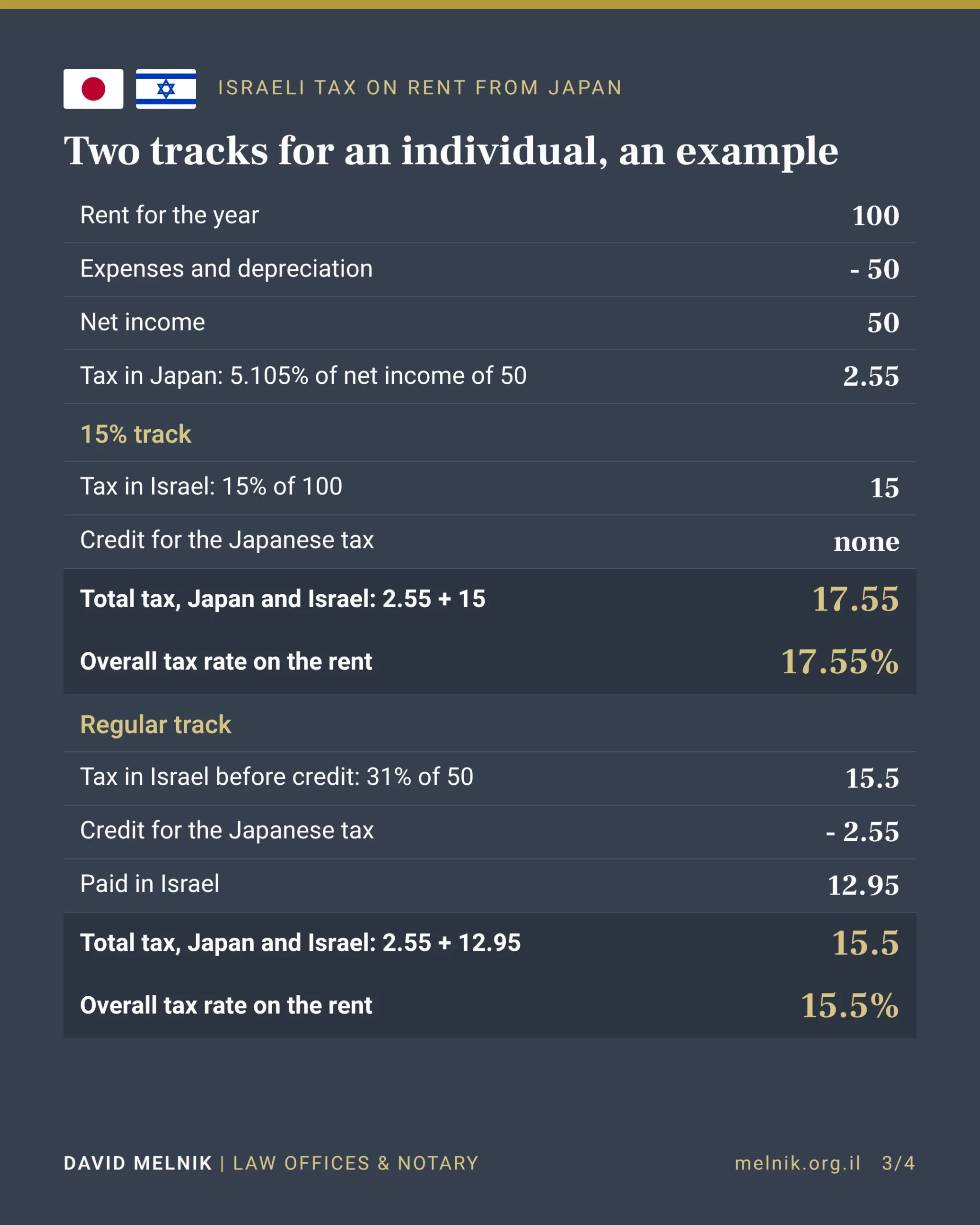
An individual resident in Israel may elect under section 122A of the Income Tax Ordinance to pay 15 per cent of the gross rent. Under this track no expenses are deductible other than depreciation, and no credit is given for the Japanese tax. Under the regular track, net income is taxed at marginal rates, and up to age 60 income that is not from personal exertion is taxed at 31 to 47 per cent, with a surtax above the threshold. The Japanese tax is credited up to the Israeli tax on the same income.
Where the Japanese tax is at the lowest bracket and the Israeli rate is 31 per cent, the regular track is cheaper once expenses, including depreciation, exceed about 42 per cent of the rent. With lower expenses the 15 per cent track is cheaper.
A new immigrant and a senior returning resident are exempt in Israel for ten years on income produced outside Israel and on capital gains from the sale of an asset outside Israel, including rent from and gains on an apartment in Japan.
Tax on the sale of an apartment in Japan
The convention allows Japan to tax gains on the sale of real estate located there. The gain is the sale price less the acquisition cost, reduced by depreciation claimed on the building, and less selling expenses. A non-resident individual pays national tax of 15.315 per cent where the apartment was held for more than five years as at 1 January of the year of sale, and 30.63 per cent otherwise.
The buyer withholds 10.21 per cent of the sale price, even where the sale is at a loss. The buyer is exempt from withholding only where the price does not exceed 100 million yen and the buyer is an individual acquiring the apartment as a home for himself or his relatives. The withholding is credited in the return the seller files in Japan in the year after the sale.
In Israel, a gain on the sale of an apartment abroad is subject to capital gains tax under the Ordinance, not to land appreciation tax. An individual pays 25 per cent on the real gain, and a company pays corporate tax. In both cases the Japanese tax is credited.
Holding the apartment through a foreign company
Shares are located where the issuing company has its head office. Shares in a company incorporated outside Japan that owns the apartment are not a Japanese asset, and an heir with no connection to Japan is not liable to Japanese inheritance tax on them. Shares in a Japanese company are a Japanese asset. The convention allows Japan to tax gains on the sale of shares in a company deriving its value mainly from real estate in Japan.
Income derived through an entity that is fiscally transparent, such as a partnership or a US LLC, is treated as income of a resident of a state only to the extent that state treats it as income of its resident.
In Japan the company is liable to corporate tax on the rent. The national corporate tax rate is 23.2 per cent, and the 20.42 per cent withholding applies to a foreign company as well.
A body of persons whose business is controlled and managed from Israel is resident in Israel, even if incorporated abroad. Such a company pays Israeli corporate tax at 23 per cent on its income, with a credit for the Japanese tax. A dividend it pays to an individual is taxed at 25 per cent, or 30 per cent for a substantial shareholder. The 15 per cent track of section 122A is available to individuals only, not to a company.
A company controlled and managed outside Israel is not taxed in Israel, and the shareholder is taxed when it pays a dividend. A company controlled by Israeli residents whose income is mostly passive, and taxed abroad at no more than 15 per cent, is a controlled foreign company, and its shareholders are taxed on their share of undistributed profits. Rent from an apartment is passive income, and the national corporate tax rate in Japan exceeds 15 per cent.
In the table, rent of 100 and expenses and depreciation of 50. The Japanese tax on an individual is computed at the lowest bracket, 5.105 per cent of net income, and on the company at the national corporate tax rate of 23.2 per cent. The amounts are out of rent of 100.
| Who holds the apartment | Tax in Japan | Tax in Israel | Tax in Japan and Israel |
|---|---|---|---|
| Individual, section 122A | 2.55 | 15 | 17.55 |
| Individual, regular track | 2.55 | 12.95 | 15.5 |
| Israeli-resident company, no dividend | 11.6 | 0 | 11.6 |
| Israeli-resident company, dividend paid | 11.6 | 9.6 | 21.2 |
Three tiers of residence in Japanese tax
The extent of income taxable in Japan follows the residence tier of the individual.
| Status | Who falls within it | What is taxable |
|---|---|---|
| Resident | A person domiciled in Japan, or present there continuously for one year or more | Income from any source worldwide |
| Non-permanent resident | A resident of non-Japanese nationality present in Japan for five years or less within the preceding ten | Japanese source income, and foreign source income paid in Japan or remitted to it |
| Non-resident | Anyone outside the definition of resident | Japanese source income only |
Foreign source income accruing to a non-permanent resident and not brought into Japan is not taxable there, and a remittance to Japan in the same year, even one made for an entirely different purpose, is treated as a remittance of that income up to the amount transferred. The same applies where an apartment in Japan is bought with funds from a foreign account.
The exit tax on unrealised gains
Japan taxes unrealised gains of a person leaving the country where two conditions are met together: holding financial assets with a total value of 100 million yen or more, and residence in Japan for more than five of the ten years preceding the date of departure. Financial assets for this purpose include securities, interests in silent partnership contracts, unsettled derivative transactions, and financial assets held outside Japan.
On securities the rate is 15.315 per cent. Payment may be deferred for five years, and on a further application for up to ten, subject to appointing a tax agent in Japan, filing the return on time, and providing collateral equal to the tax and the interest. Periods spent in Japan on a status listed in Table 1 of the Immigration Act, which covers most work visas, are not counted towards the residence test. Periods on a permanent resident or spouse of a Japanese national status are counted.
Sources
Israeli Income Tax Circular 6/94 on the Israel Japan tax treaty · Israeli Income Tax Circular 1/2022 on the MLI · ITA 1255/02 Jetec Technologies v. Assessing Officer Kfar Saba · Convention between Japan and the State of Israel for the Avoidance of Double Taxation and the Prevention of Fiscal Evasion with respect to Taxes on Income, 8.3.1993, Articles 2 and 10 to 13 · Ministry of Finance, Japan, Application of the MLI to the Tax Treaty between Japan and Israel · National Tax Agency, Japan, Taxpayers and the scope of taxable income · Estate Tax Law, 1949, repealed in 1981 · Income Tax Ordinance, sections 1, 14, 75B, 91, 122A and 125B · National Tax Agency, Japan, No.12014 Real estate income of non-residents · Foreign Exchange and Foreign Trade Act (Japan), Article 55-3 · Ministry of Finance, Japan, Report on acquisition of real estate by non-residents
General overview. The figures are correct as at 30 September 2026 and are not a substitute for specific advice on Japanese law.