Acquiring an Israeli Company Through a Leveraged Subsidiary: When Does It Become an Artificial Transaction
The Israeli District Court dismissed an appeal and held that extracting $86 million in profits from Israel, structured as repayment of a shareholder loan, amounted to an artificial transaction under Section 86 of the Tax Ordinance.
Many companies, foreign funds acquiring Israeli companies in particular, choose to fund the acquisition through a shareholder loan rather than equity, for a range of entirely legitimate commercial reasons that have nothing to do with tax. A recent judgment addressed exactly this question: when such funding is legitimate, and when it amounts to an artificial arrangement designed to avoid the tax due on profits distributed to a foreign company.
01Summary
A foreign investment fund acquired a successful Israeli cybersecurity company. It did not acquire the company directly, but through an Israeli shelf company set up for the purpose, which was funded by loans from the foreign parent totalling roughly $70 million. Over the following years the shelf company repaid those loans out of funds it received from the acquired company, partly as dividends and partly as further loans, so that in total around $86 million left Israel for the foreign parent, all of it framed as loan repayment rather than as a distribution of profits.
The question at the heart of the case was, in substance, a question of characterisation: was this a genuine loan repayment, which would not be taxable, or did the payments, whatever their legal wrapping, carry the economic substance of a dividend, which is taxable when transferred to a foreign company. The tax authority argued for the latter, invoking Section 86 of the Ordinance, an anti-avoidance provision that authorises it to disregard an artificial transaction and tax it according to its true substance.
The court accepted the tax authority’s position, holding that the sequence of steps amounted to an artificial transaction and that the payments should be taxed as a dividend. The appeal was dismissed, though the penalty for failing to withhold tax at source was cancelled.
No one disputed the legal validity of the loan agreements themselves: they were signed, interest was paid on them, and tax was withheld at source on that interest. The question was not whether the loan was real, but whether there was a genuine commercial reason for setting up the structure through which it was given.
02Background: two-tier taxation
Israel’s tax system separates the taxation of a company from the taxation of its shareholders. At the first tier, corporate tax is levied on the company’s taxable income. At the second tier, when profits are distributed as a dividend, a further tax is levied on the shareholders.
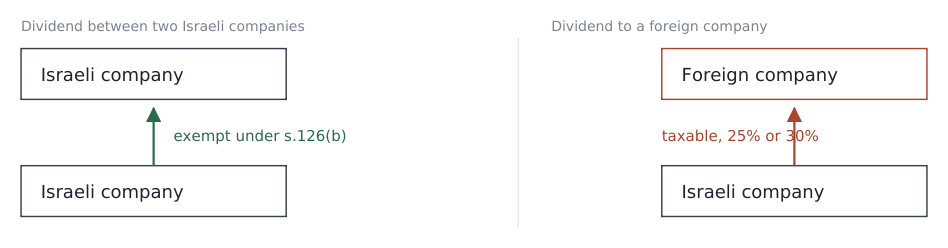
Section 126(b) of the Ordinance provides that a dividend distributed between two Israeli-resident bodies of persons is not included in the recipient’s taxable income, on the rationale that the profits have already borne corporate tax, and the second tier will arrive in due course, once the funds reach an individual.
But where the recipient is a foreign company, the Israeli chain of taxation reaches its end. There is no longer a future distribution to wait for, so the inter-company exemption does not apply. Section 125b(5) imposes tax of 25%, or 30% for a substantial shareholder, subject to relief under double-tax treaties.
03The facts
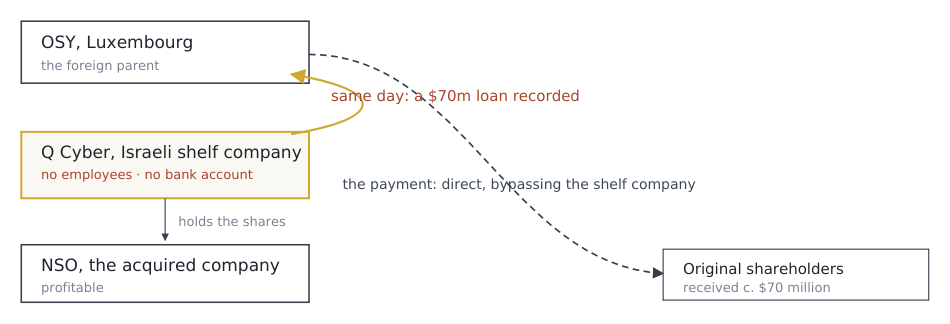
A foreign investment fund decided to invest in cybersecurity and negotiated the acquisition of an Israeli company, in a transaction carried out through a Luxembourg-resident company it controlled. In parallel, an Israeli shelf company was acquired, established as an empty shell: at the time of acquisition it had no activity, no employees, and did not even have a bank account.
On completion, the Luxembourg company paid approximately $70 million directly from its own accounts to the shareholders of the acquired company, without the funds passing through the shelf company. On that same day, loan agreements were signed and loans from the parent company in a matching amount were recorded in the shelf company’s books. The shares were transferred to it the following day.
The accounting significance
The shelf company recorded, on its books, an asset in the form of a share investment, and against it a liability in the form of debt owed to the parent. In practice, no funds passed through it at all.
At the parent company, the same $70 million was recorded as a loan advanced, not as an investment in shares.
04Extracting the profits
In the years that followed, the shelf company repaid the loans to the parent using dividends and further loans it received from the acquired company, until the total transferred exceeded $86 million. Here too the funds were transferred in practice directly from the acquired company to the parent, without passing through the shelf company’s bank account, but were recorded in its books as required: received from the acquired company, and paid on to the parent as loan repayment.
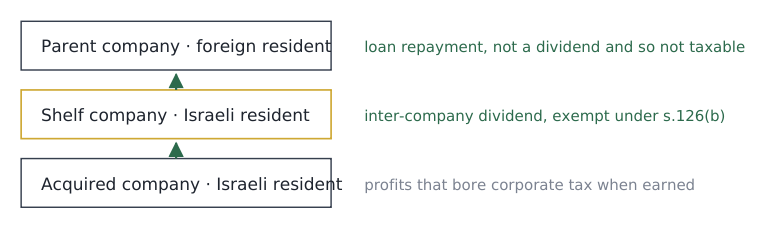
Under the double-tax treaty with Luxembourg, had the payments been characterised as a dividend, tax of 10% would have applied. The scale of the saving was therefore around $8.6 million.
05The legal framework
The court began by recognising a taxpayer’s right to arrange his economic affairs so as to minimise his tax liability, a right treated as part of his constitutional right to property. A taxpayer is not obliged to choose the path that leads to the maximum tax.
Alongside this, Section 86 of the Ordinance sets out a general anti-avoidance norm, authorising the assessing officer to disregard a transaction that reduces tax if it is artificial, or if one of its principal purposes is an improper reduction of tax.
The court made two clarifications. First, the term “transaction” is construed broadly and encompasses the entire sequence of steps, so that a fragmented examination does not defeat the exposure of artificiality. Second, the fact that a step was taken lawfully and was not prohibited by the legislature does not preclude a finding that it is artificial.
The two-stage test
The first stage classifies the tax planning. Positive planning exploits an incentive or exemption the legislature deliberately granted. Neutral planning makes a considered choice between alternatives the legislature left open to the taxpayer. Negative planning exploits a gap in the legislation contrary to its purpose. Only if the planning is found to be negative does the analysis proceed to the second stage.
The second stage tests whether the commercial purpose is fundamental. A commercial purpose that is incidental or marginal will not do. The commercial purpose must be a fundamental reason for structuring the transaction as it was structured, meaning that but for the expectation of its being realised, the taxpayer would not have entered into the transaction in that way.
Supporting tests
- Credibility of the commercial purpose: presenting real evidence that the purpose claimed genuinely underlay the transaction
- Economic proportionality: a quantitative comparison between the scale of the commercial purpose and the scale of the tax saving
- Economic substance: whether, at the time of the transaction, there was a reasonable expectation of economic profit
- The risk test: the level of risk the taxpayer bore, against the certainty inherent in the tax saving
Allocation of the burden
The assessing officer bears the initial burden of demonstrating objectively that the transaction appears, on its face, to be artificial. Once that burden is discharged, it shifts to the taxpayer, who holds the best evidence, to prove by real evidence a fundamental commercial purpose.
06The central finding
The court made clear that there is nothing wrong with leverage as such, and that this question was not in dispute at all. It noted, moreover, that the legislature had deliberately refrained from enacting thin-capitalisation rules, and that proposals on the subject had been raised and rejected.
The court further held, and this is the crux of the matter, that the very same structure might well be legitimate:
From the judgment, paragraphs 80-81
“The foregoing does not mean that one cannot proceed by establishing a company in Israel, with a loan given to it by a foreign-resident parent company, for the purpose of acquiring shares in an Israeli company. Conduct of this kind may well be considered legitimate, but given the two-tier taxation framework set by the legislature, it may also not be.”
“The same act may therefore sometimes be regarded as legitimate, and sometimes not. The difference lies in the purpose of the acts, and the manner in which that purpose was in fact realised.”
The reduction in tax, the court found, was plain and evident: had the shares been held directly by a foreign-resident company, it would not have been possible to transfer the profits of the acquired company to it without tax. Once an Israeli-resident company was established, the profits could be distributed to it exempt, and from there returned to the parent as repayment of a loan.
The reason the same structure can be sound in one case and artificial in another is an economic distinction. Suppose the foreign company wanted to acquire the Israeli company itself, directly: it pays $70 million out of its own pocket and receives the shares in return, and on its own books that $70 million becomes equity, a share investment. Equity ordinarily comes back to the shareholder as a dividend, and when the dividend goes to a foreign company it is taxable. Now suppose the very same acquisition, for the same amount, except that the foreign company does not buy directly but instead lends the sum to another Israeli company, which is the one that buys and holds the shares. At the foreign company, that same $70 million is now recorded not as a share investment but as a loan advanced, and debt, unlike equity, returns as repayment, and repayment of principal is not a dividend. The foreign company paid out the same sum in both cases, and in both cases the money reached the same original shareholders; the only difference is how it was recorded on its books, and that in turn determines through which door the money can be brought back out.
It follows that inserting an Israeli intermediate company, funded by a shareholder loan, is itself what makes it possible to convert equity into debt, without the foreign company ceasing to be the beneficial owner and without it having to acquire directly. And from this follows the test the court applied: the use of leverage as such is entirely legitimate, and no one disputed that, but the question is why the intermediate company was needed at all. If the only answer is to enable this conversion from equity to debt, that is negative tax planning; if the intermediate company has an independent and substantial commercial purpose (such as risk isolation, consolidation of activity, or use as a platform for further acquisitions) that would have existed regardless of the tax consideration, the structure may stand. This is why the question, in the court’s words, is essentially an evidentiary one: not what the legal structure was, but what actually lay behind it, and how that can be proven.
07Why the appeal was dismissed
The court found that the assessing officer had discharged the initial burden, and that the appellant had not discharged the burden that shifted to it. The reasoning turned almost entirely on evidentiary points.
| The argument raised | Why it was not accepted |
|---|---|
| The company was established to serve as a platform for further acquisitions | Not a single document from the due diligence process said to have been carried out was produced. The court held that failing to produce documents that exist gives rise to a presumption that, had they been produced, they would have counted against the taxpayer |
| The company served as a marketing and distribution hub for the group | That activity developed roughly two years after the acquisition. No evidence was produced that, at the time of the transaction, this was a principal and substantial purpose |
| Export-control regulatory constraints | Raised at a late stage, unsupported by evidence, and not mentioned to the assessing officer at the time |
| A signed assessment agreement created an estoppel | The agreement itself stated expressly that the question of the repayments would be addressed in a withholding-tax assessment |
Two further matters deserve mention. First, no one from the foreign fund was called to testify as to the considerations at the time, and the failure to call such a witness was held against the appellant. Second, the expert opinion submitted addressed the general prevalence of leverage rather than this specific transaction.
On economic proportionality, the court set the figures side by side: the tax paid in Israel on the marketing and distribution activity came to under $1.25 million, against a tax saving of more than $8.6 million.
What did not, in fact, decide the case
The arguments concerning the same person signing on behalf of both sides, and funds being transferred other than through the company’s bank account, were accepted at face value: shared management functions within a group of related companies, and a saving on unnecessary banking fees. The court gave them no real weight.
08The outcome
The appeal was dismissed. The payments transferred to the parent company were taxed as a dividend, at the rate set under the treaty.
At the same time, the court cancelled the penalty for failing to withhold tax at source under Section 191A, holding that although this was tax planning that could not be accepted, the dispute did not reflect fraudulent or false conduct warranting a penalty.
It was further held that tax withheld at source on the interest payments would offset the tax liability, and that the amount treated as a dividend would not exceed the sum that could lawfully have been distributed under company law. The appellant was ordered to pay costs of NIS 40,000.
09Conclusion
The judgment does not hold that a structure in which an Israeli company is funded by a shareholder loan from a foreign parent is inherently improper. Quite the opposite: the court said explicitly that it may well be legitimate.
What was decided is that the outcome turns on the purpose behind the acts and how that purpose was in fact realised, and that this is essentially an evidentiary question. In the case at hand, the Israeli company was an empty shell at the time of acquisition, the funds never passed through it, and the economic substance later attributed to it developed some two years afterwards, while none of the arguments raised were supported by contemporaneous evidence.
Note: This review is provided for informational purposes only and does not constitute legal advice or a legal opinion.
Questions and answers
Is funding an Israeli acquisition through a shareholder loan from a foreign parent improper in itself?
No. The court made clear that there is nothing wrong with leverage as such, and that this question was not in dispute. It noted that the legislature had deliberately refrained from enacting thin-capitalisation rules, and that proposals on the subject had been raised and rejected. In paragraphs 80 to 81 the court said conduct of this kind may well be considered legitimate, and given the two-tier taxation framework, may also not be.
Why does it matter whether the money leaves Israel as a dividend or as loan repayment?
Section 126(b) of the Ordinance provides that a dividend distributed between two Israeli-resident bodies of persons is not included in the recipient’s taxable income. Where the recipient is a foreign company the Israeli chain of taxation reaches its end and the inter-company exemption does not apply. Section 125b(5) imposes tax of 25%, or 30% for a substantial shareholder, subject to treaty relief. Under the Luxembourg treaty a dividend would have carried 10%.
What exactly was the structure the court examined?
A foreign fund acquired an Israeli cybersecurity company through a Luxembourg company it controlled, using an Israeli shelf company that had no activity, no employees and not even a bank account. The Luxembourg company paid roughly $70 million directly to the sellers, and on the same day loan agreements in a matching amount were recorded in the shelf company’s books. Over the following years around $86 million left Israel, framed as loan repayment.
The loan agreements were genuine and interest was paid on them. Was that not enough?
No one disputed the legal validity of the loan agreements: they were signed, interest was paid, and tax was withheld at source on that interest. The question was not whether the loan was real, but whether there was a genuine commercial reason for setting up the structure through which it was given. The court also held that the term transaction is construed broadly and encompasses the entire sequence of steps.
What test does Section 86 apply?
The first stage classifies the tax planning. Positive planning exploits an incentive the legislature deliberately granted, neutral planning chooses between alternatives left open, and negative planning exploits a gap contrary to the legislation’s purpose. Only negative planning proceeds to the second stage, which tests whether the commercial purpose is fundamental, meaning that but for the expectation of its being realised, the taxpayer would not have entered into the transaction in that way.
Who has to prove what?
The assessing officer bears the initial burden of demonstrating objectively that the transaction appears, on its face, to be artificial. Once that burden is discharged, it shifts to the taxpayer, who holds the best evidence, to prove by real evidence a fundamental commercial purpose. Supporting tests include the credibility of the commercial purpose, economic proportionality, economic substance, and the level of risk borne against the certainty of the tax saving.
Our intermediate company did develop real activity after the acquisition. Does that save the structure?
In this case the marketing and distribution activity developed roughly two years after the acquisition, and no evidence was produced that at the time of the transaction this was a principal and substantial purpose. On economic proportionality the court set the figures side by side: tax paid in Israel on that activity came to under $1.25 million, against a tax saving of more than $8.6 million.
Was a penalty imposed for failing to withhold tax at source?
The appeal was dismissed and the payments were taxed as a dividend at the treaty rate, but the court cancelled the penalty under Section 191A, holding that although this was tax planning that could not be accepted, the dispute did not reflect fraudulent or false conduct warranting a penalty. Tax withheld at source on the interest payments offsets the liability, and costs of NIS 40,000 were awarded.