Certainty Without Mercy: Consensus Engineering versus Business DiscretionThe journey of property from the physical world to the digital one By Adv. David Melnik In HBO’s documentary Money Electric: The Bitcoin Mystery, director Cullen Hoback sets out to solve one of the great enigmas of the digital age: who stands behind Bitcoin. The revolution began in October 2008, at the height of the global financial crisis, with the publication of a nine-page document under the pen name Satoshi Nakamoto. When I first read the document, I found myself returning to the foundational principles of property law from my second year of law school. The text is a technological and mathematical manifesto, written out of a collapse of trust in the banking system and a wish to create a decentralized alternative. Yet beyond the cryptographic aspects of encryption, Satoshi had to confront one of the oldest questions in property and commerce: how do you guarantee publicity, reliability, and above all exclusivity, so that each asset is allocated to one owner alone and is not sold or “transferred” more than once, a problem known in the digital world as double-spending, in a system where every party has a built-in economic incentive to cheat. Satoshi’s solution is nothing but a digital implementation of principles that property law had crystallized long before him. 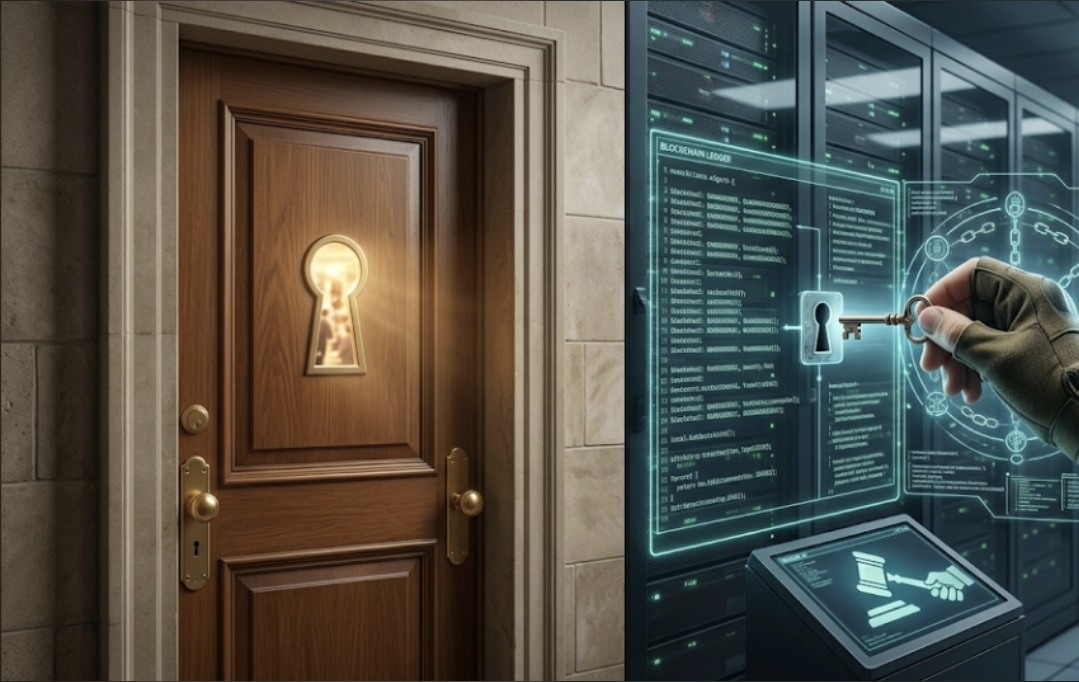 The Ledger’s Arms RaceIn the physical world, exclusivity is guaranteed on its own. If I hand you a two-hundred-shekel note, it is with you and therefore not with me, and it cannot be held in two places at once. The laws of physics rule. But in the realm of rights, and certainly in the digital realm, exclusivity breaks down: the same right, and the same file, can be duplicated and appear in two places at the very same time. This was the technological barrier that prevented true digital money until Bitcoin appeared. Consider conflicting transactions in real estate. An owner signs a sale contract with Buyer A, and a month later sells that very same parcel to Buyer B. Both paid consideration, but there is only one parcel. To whom does it belong? Israeli property law calls this “conflicting transactions” and decides the race under Section 9 of the Land Law, broadly comparable to a race-notice priority rule, which enshrines an ancient principle: first in time prevails. But priority is fixed by the date the contract was formed, not by registration, and it is not absolute either: the second buyer prevails only if he gave consideration, acted in good faith, and completed the registration while still in good faith. Here the cautionary note (he’arat azhara) enters, a caveat recorded against the title, similar to a notice or lis pendens that warns third parties. The moment the first buyer records it, the transaction becomes public: the registry will refuse to record a conflicting transaction (Section 127), and no one can any longer claim he did not know, so the “second buyer” exception in Section 9 no longer avails him. In this way the cautionary note thwarts the double allocation before it occurs. The final stage, conclusive registration in the Tabu (Israel’s land registry), is the moment the right is perfected: the contractual right, personal and good only against the seller, becomes a proprietary right good against the whole world, rigid and almost irreversible, which the rules of limitation and the market-overt doctrine (takanat ha’shuk, Section 10, a good-faith-purchaser protection comparable to indefeasibility of title in Torrens systems) only harden as time passes. 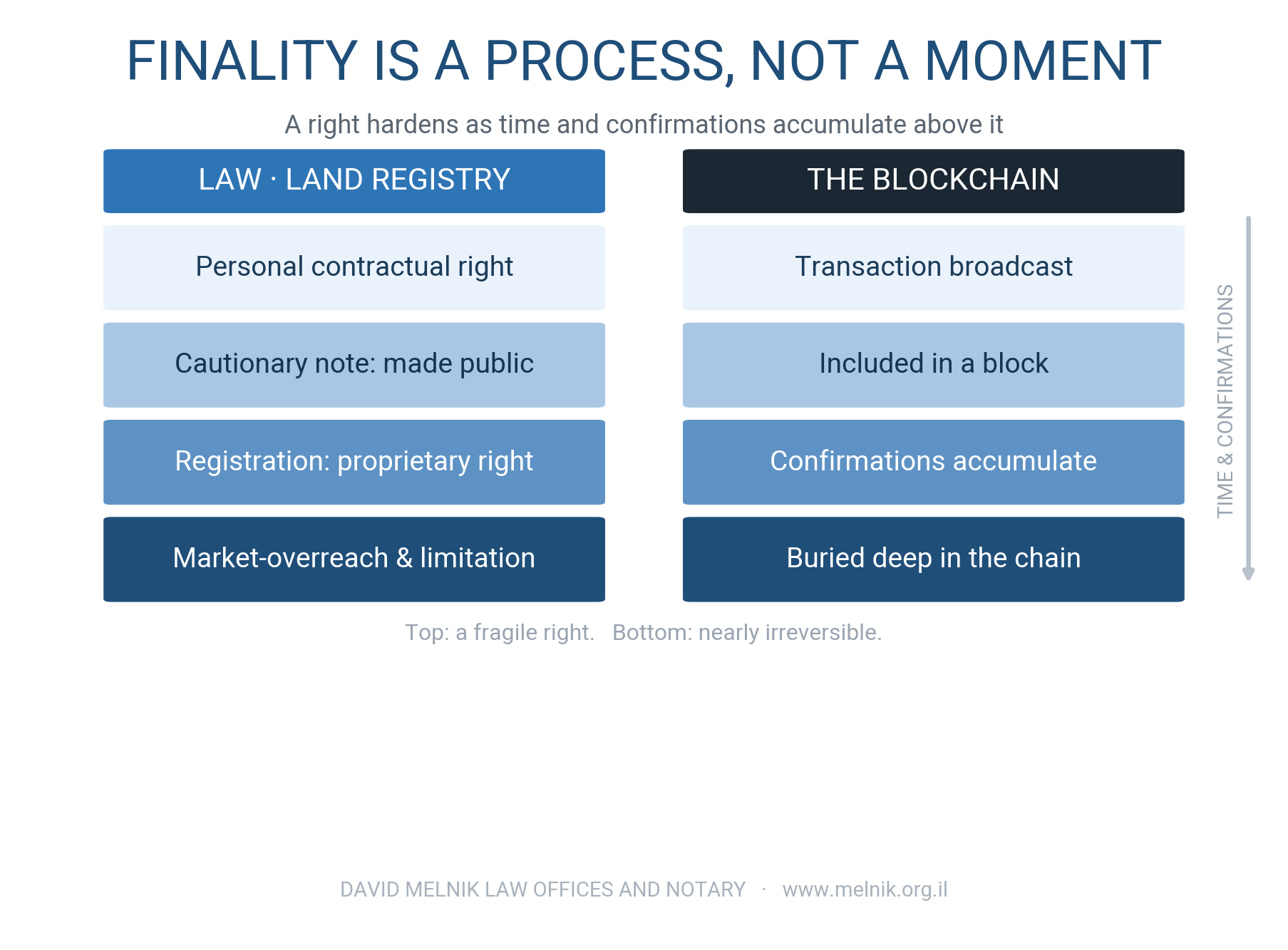 In the digital realm the problem is even sharper, since a computer file is an open invitation to copy and paste. This is the Double-Spending Problem: how do you prevent a user from sending the same digital coin to two recipients at the very same time. In those nine pages Satoshi solved precisely this problem, without lawyers, without central banks, and without courts. The solution was based on the Proof of Work mechanism (Hashcash) of Adam Back, and the b-money digital-currency proposal of Wei Dai. The historical solution to both problems was identical: a central third party that maintains a public, unified ledger. In the world of money this is the central bank, which issues fiat (currency based on governmental trust rather than physical value); in real estate it is the land registry. But centralization carries a price tag: a single point of failure. If the central body collapses, is corrupted, or is breached, it may bring the entire system down with it. Consensus Engineering: The Law’s Own “Proof of Work”Bitcoin’s stroke of genius was a decentralized decision mechanism grounded in game theory: a practical solution to the Byzantine Generals Problem, how to reach reliable agreement in a network in which some participants may cheat. Satoshi designed the incentives so that honest behavior would be the most rational strategy, a Nash Equilibrium, and an attack would become economically unprofitable. In an anonymous network you cannot run a “one identity, one vote” ballot, because an attacker can generate millions of virtual identities at zero cost. Whoever decides by the number of identities decides, in effect, by whoever can forge the most, not by whoever is right. To neutralize this, the system ties the right to vote to a costly resource that cannot be forged from the physical world: computing power and energy. The mechanism, Proof of Work, requires the computers to crack a guessing-based puzzle: to find a number that turns the digital “fingerprint” (hash) of the block into a string beginning with a certain number of zeros. There is no shortcut, only billions of expensive guesses, yet verifying the solution is instantaneous. This is deterministic evidence (a result dictated by rigid rules in which a given input always leads to an identical output, without randomness, emotion, or interpretation) that real effort was invested here. To put a tangible number on it: mining a single bitcoin today consumes roughly 850,000 kilowatt-hours, about as much electricity as an average household uses in some eighty years, and that is the real effort embedded in every coin. Weight is assigned by “one CPU, one vote,” and the truth is simply the longest chain, the one behind which the greatest computational capital has accumulated. This enormous cost is precisely the source of the network’s security: it is what renders any attempted attack unprofitable, as the following example will show. To forge the Bitcoin chain and carry out a double-spend, an attacker must seize a majority of the network’s computing power. As of late 2025, the cost of such a move was estimated at more than two million dollars per hour, and acquiring the necessary hardware alone runs into the billions. And even then the attacker loses: the very visibility of the attack would crash Bitcoin’s value, so the loot would erode before it could be realized, whereas that same hardware, if used honestly, would yield a greater profit. Thus honesty becomes not merely lawful, but the most profitable strategy. 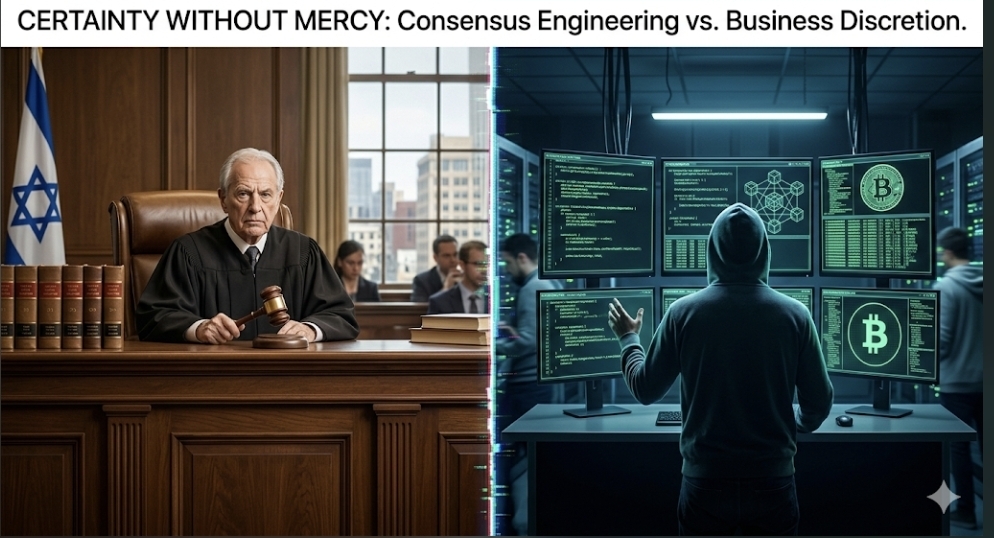
Questions and answersWhy is exclusivity a problem for digital assets but not for a banknote?In the physical world exclusivity is guaranteed on its own. If I hand you a two-hundred-shekel note, it is with you and therefore not with me, and it cannot be held in two places at once. In the realm of rights, and certainly in the digital realm, the same right and the same file can be duplicated and appear in two places at the very same time. That was the technological barrier that prevented true digital money until Bitcoin appeared. The seller signed a contract with me and then sold the same parcel to someone else. Who gets it?Israeli property law calls this conflicting transactions and decides the race under Section 9 of the Land Law, which enshrines an ancient principle: first in time prevails. Priority is fixed by the date the contract was formed, not by registration. The second buyer prevails only if he gave consideration, acted in good faith, and completed the registration while still in good faith. What does a cautionary note actually achieve?The moment the first buyer records it, the transaction becomes public: the registry will refuse to record a conflicting transaction under Section 127, and no one can any longer claim he did not know, so the second buyer exception in Section 9 no longer avails him. It is the equivalent of propagating a transaction to every node in a network, after which no honest node will include a conflicting transaction. Why can’t an attacker simply create millions of identities and outvote the network?In an anonymous network a one identity, one vote ballot fails, because an attacker can generate millions of virtual identities at zero cost. To neutralise that, the system ties the right to vote to a costly resource that cannot be forged: computing power and energy. Weight is assigned by one CPU, one vote, and the truth is the longest chain, the one behind which the greatest computational capital has accumulated. How expensive would an attack on Bitcoin actually be?To forge the chain and carry out a double-spend, an attacker must seize a majority of the network’s computing power. As of late 2025 the cost was estimated at more than two million dollars per hour, and acquiring the hardware alone runs into the billions. Even then the attacker loses: the visibility of the attack would crash the value, so the loot would erode before it could be realised. What happens on a blockchain when a private key is lost?The pure blockchain is deterministic, rigid and blind, devoid of an Undo button. Once data is recorded on the chain it cannot be altered or deleted, since rewriting the past would demand that same prohibitive attack cost. The QuadrigaCX collapse is the documented case: the founder died suddenly in 2018 and with him vanished the only private keys to customers’ funds, hundreds of millions of dollars locked away forever. If code is law, how were the DAO funds recovered in 2016?A hacker exploited a flaw in the code and drained tens of millions of dollars. As far as the dry code was concerned no offence was committed, only a use of functions the system permitted. Faced with the loss of capital the community carried out a forceful political intervention, split the network in a hard fork, and rewrote history to recover the funds. Those who insisted the code is the code remained on the original chain, Ethereum Classic. Can smart contracts combined with artificial intelligence replace a judge?They can narrow the gap. Smart contracts running on decision trees can be programmed to weigh extreme price anomalies, indicators of bad faith or known fraud patterns, and halt a suspicious transaction in real time. But decision trees deal with the foreseeable, with thresholds and patterns defined in advance. The DAO flaw appeared in no decision tree because no one had imagined it, and a hard core of unforeseeable circumstances remains. Further readingCrypto and digital inheritanceDigital assets, keys and proof of ownership in an Israeli estate.Tokenized real estateWhat a property token actually grants and what remains unregulated.EU AI Act enforcementScope, duties and exposure for Israeli companies under the Act.AI generated intimate imageryProvider liability and the prevention measures the new prohibition requires.
In the world of law, the date of contract formation is the timestamp of the transaction, just as broadcasting a transaction to the network marks its place in line. The cautionary note is the equivalent of propagating the transaction to every node: once everyone has “seen” it, no honest node will include a conflicting transaction, just as no buyer can any longer claim he did not know. And the final registration, like a transaction buried under many blocks (confirmations), is the moment of perfection: the passage from a fragile right to a rigid one. In both worlds, finality is not a moment but a process, strengthening exponentially as confirmations, time, and reliance pile up above it. The law, then, also demands its own proof of work: the writing requirement, signatures, identification, and publicity. The chain of ownership recorded in the registry is the equivalent of the longest chain of blocks. In both worlds, the winner is not whoever shouts loudest, but whoever has the public record standing behind him, the one whose production is expensive and hard to forge. The Point of Divergence: Deterministic Code versus a Human JudgeAt one decisive junction, the risk-management junction, the two worlds part entirely. The legal system is built on the understanding that formal rules must sometimes “yield” to discretion and to equity. A judge of flesh and blood is empowered to look at a transaction, identify fraud, exploitation, or error, and correct the registry retroactively. There always remains a narrow crack through which “justice” can knock on the door and open even a registration that appeared closed. (Some will argue, conversely, that this very flexibility is a source of uncertainty, that human discretion may look as arbitrary as a coin toss. We will return to that argument shortly.) The pure blockchain is the exact opposite: a deterministic, rigid, blind system, devoid of an Undo button. This is the property of immutability: once data is recorded on the chain it can no longer be altered or deleted, since rewriting the past would demand that same prohibitive attack cost. The governing rule is Code is Law, and the chain is the truth, regardless of circumstances. Once a transaction is buried deep in the chain, the door locks hermetically. The concrete nightmare of this architecture was documented in another film, this one by Netflix: Trust No One: The Hunt for the Crypto King, which follows the collapse of the crypto exchange QuadrigaCX. Its founder died suddenly in 2018, and with him vanished the only private keys that gave access to customers’ funds, hundreds of millions of dollars locked away forever, with no legal or technological way to overcome the mathematics. And the principle of Code is Law was put to its hardest test in the DAO affair of 2016. The DAO (a Decentralized Autonomous Organization, an entity that runs purely on rules written into smart contracts, with no central management) was a decentralized investment fund on the Ethereum network, in which a hacker exploited a flaw in the code and drained tens of millions of dollars. As far as the dry code was concerned, no offense was committed, only a use of functions the system permitted. Code is law. But faced with the loss of capital, human beings refused to accept the “mechanical justice”: the community carried out a forceful political intervention, split the network (a hard fork), and rewrote history in order to recover the funds. Automation was forced to bend before human discretion. (Those who insisted that the code is the code remained on the original chain, which exists to this day under the name Ethereum Classic, and so the two philosophies split into two separate coins.) The Reverse Question: Is a Human Judge the Solution?But here it is worth turning the question around. If the code is too rigid, is the human judge truly the solution? Classical law sanctifies discretion as a brake against the cruelty of the code, yet it ignores the weaknesses of the human being: judges err and are swayed by biases, and the process itself, in the registry and in the courts, is slow, expensive, bureaucratic, and generates ongoing business uncertainty. If the code is too blind and the human too subjective, perhaps the solution lies precisely in the middle. Here the smart contracts (Smart Contracts) enter: autonomous snippets of code that run on the blockchain and automatically perform a defined action the moment a condition is met (“if X, then Y”). Combined with artificial-intelligence mechanisms based on decision trees, they cease to be blind: they can be programmed to weigh extreme price anomalies, indicators of bad faith, or known fraud patterns, and to halt a suspicious transaction in real time, at the speed of code but with a built-in ability to examine circumstances, without the delay and costs of the courthouse. But even decision trees, however smart, deal with the foreseeable: with the thresholds, patterns, and signs defined in advance. The essence of human discretion is precisely the opposite, the ability to respond to the unforeseeable, to that borderline case no one anticipated and therefore no one programmed, what is called a “black swan” (after Nassim Taleb): a rare and unforeseeable event whose consequences are the most enormous of all. The DAO affair is the perfect demonstration: the flaw appeared in no decision tree, simply because no one had imagined it in advance. And so the combination of smart contracts and artificial intelligence can greatly narrow the gap between code and justice, but cannot eliminate it. There will always remain a hard core of unforeseeable circumstances where human discretion still holds the advantage. The Bottom LineBitcoin presented a brilliant engineering solution for establishing chronological priority, and proved that complex rights can be managed without a central third party. But the real challenge is not to choose between the blind cruelty of the code and the slow subjectivity of the law. The future belongs to an architecture that knows how to combine: the efficiency and publicity of the decentralized ledger, together with smart layers of smart contracts and decision trees, and above them, at the place where the unforeseeable occurs, the human hand. Only such a combination restores to the system what automation tried to destroy: the ability to identify a distortion, to admit a mistake, and to correct it. And perhaps this is the conclusion itself: to whom would you entrust the management of your rights, to a human judge, to blind deterministic code, or to a combined system of smart contracts and artificial intelligence? The answer, honestly, depends on the outcome. As long as the transaction is rolling in your favor, you will bless the cold certainty of the code; but the moment you are the side that erred, whose key was lost or whose signature was obtained by fraud, you will desperately search for that human crack in the door. And conversely, a wrong outcome from a judge who acted out of bias will make you crave a deterministic system, where even a coin toss seems fairer than bias. Every system is prone to its own kind of failure, and we discover its price only from the wrong side of the error. We do not choose the right architecture in advance; it is revealed precisely at the moment of failure. So which side of the error would you have prepared for? |